
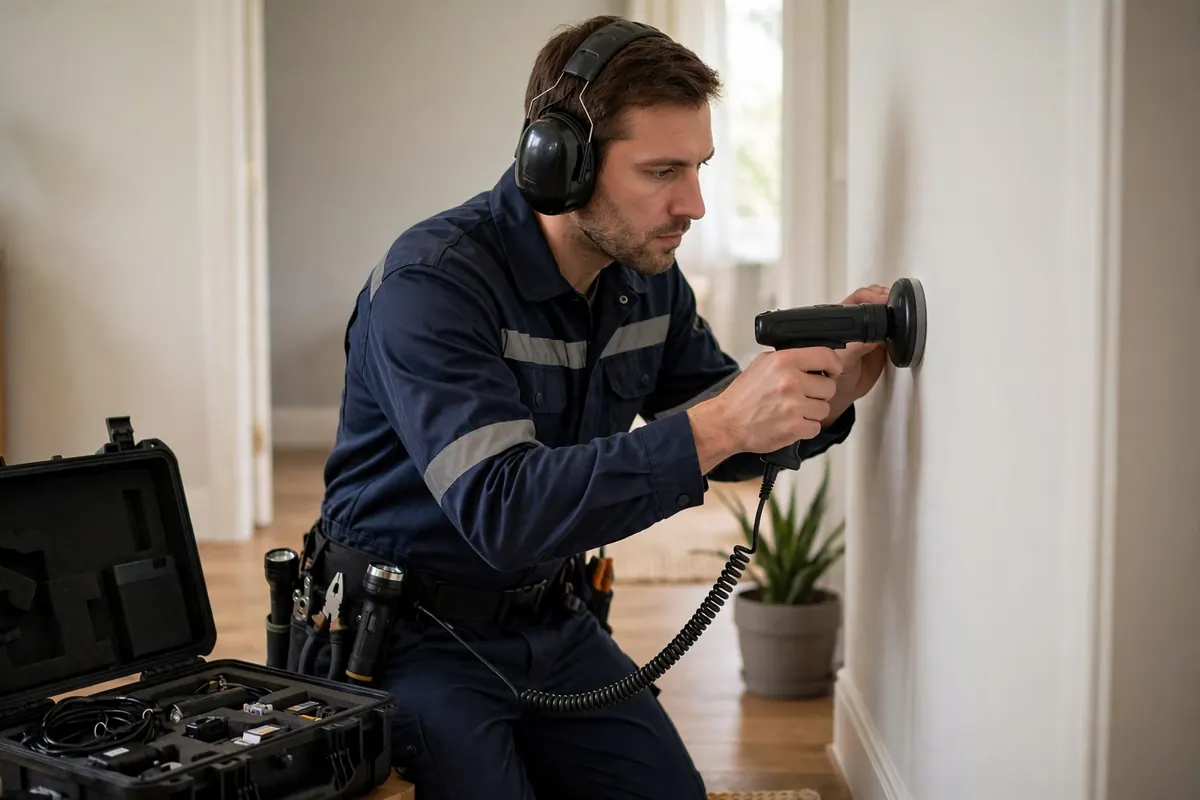
Pressurized water escaping through a break makes a distinct sound — a hiss, a whoosh, a vibration in the pipe wall. Acoustic leak detection uses electronic listening equipment to hear that sound through soil, concrete, and flooring, and trace it to its loudest point. It's the workhorse method behind most supply-line leak finds.
You'll see this method called electronic leak detection or sonic leak detection elsewhere — same equipment, same principle, different jargon. 'Acoustic' is the consumer term; 'electronic' is trade-speak and 'sonic' is equipment marketing. One page, one method, no confusion.
Signs You May Need Acoustic Leak Detection
- Hissing or running-water sounds with fixtures off
- Bill spike pointing to a supply-line loss
- Warm spots suggesting a hot-water break
- Soggy yard areas over a buried line
- Meter moving with everything off
- Vibration felt in exposed pipes
How Electronic Listening Works
A ground microphone or pipe-contact sensor picks up the vibration that escaping water creates in and around the pipe. The operator moves the sensor along the suspected route; the signal grows louder approaching the break and fades past it. Experienced operators also read the sound's character — a sharp hiss near the surface versus a deep rumble from a deep line tells you something about what you're hearing.
Where Acoustic Detection Excels
Pressurized supply lines are its home turf: main service lines in yards, copper and galvanized lines under slabs, and any buried line carrying pressure. It works through concrete, soil, and most flooring — which is why it's the primary method for slab leaks and main-line breaks alike.
Where It Struggles — Honestly
Plastic pipe (PEX, PVC, poly) muffles sound dramatically, and very small leaks may be too quiet to isolate. Noisy environments — traffic, pumps, wind — raise the noise floor. When acoustic hits its limits, we don't guess: we switch methods, using pressure testing or thermal confirmation instead. A method's limits are part of the service, not a secret.
Tracer Gas: The Backup Method
When a leak is too small to hear or the pipe material swallows sound, we may use tracer gas: a safe, inert blend of 5% hydrogen and 95% nitrogen introduced into the isolated line. The gas escapes at the break, rises through soil or concrete, and a sensitive detector sniffs it at the surface. It's a diagnostic tool for difficult cases — not a DIY technique, and never something to attempt with actual fuel gas. If you suspect a natural gas leak, leave the area and call 911 and your gas utility; that is a different emergency entirely.
Acoustic vs Thermal: Different Jobs
These two methods get confused because both are 'non-invasive detection.' The boundary is simple: acoustic finds pressurized leaks by sound; thermal finds hidden moisture by temperature. Acoustic is for supply lines, slabs, and yards. Thermal is for walls, ceilings, and hot-water patterns. We use whichever the evidence calls for — and both when confirmation matters.
Suspect a acoustic leak detection?
One visit confirms it and marks the exact position — before anyone digs.
☎ Call +1 951-508-0132Our Acoustic Leak Detection Process
Confirm pressure loss
Meter and pressure checks verify a supply-side leak exists before listening begins.
Survey the route
Sensors sweep the suspected line — yard, slab, or wall — mapping signal strength.
Triangulate the peak
Multiple readings from different angles narrow the loudest point.
Confirm or escalate
Clear peak gets marked; weak signals trigger tracer gas or thermal cross-check.