
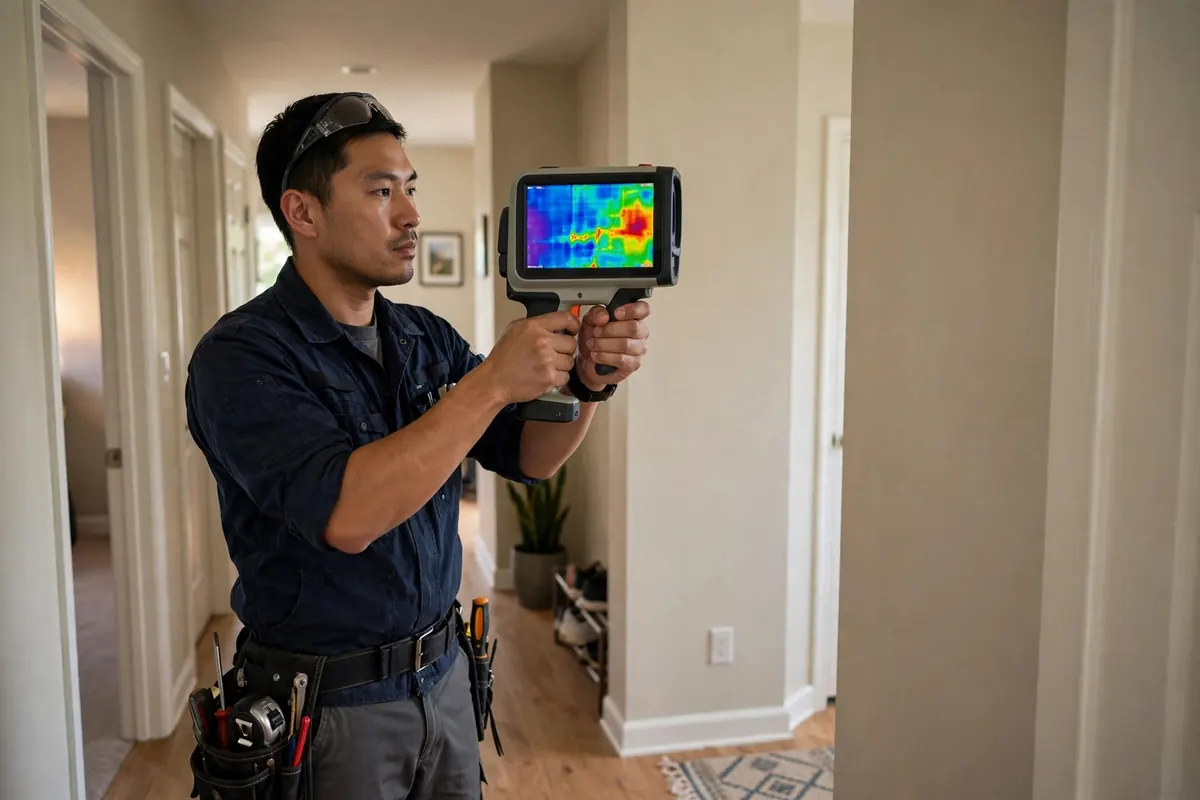
Water changes temperature — and an infrared camera sees it. Thermal imaging (also called infrared leak detection) reveals the temperature footprint of hidden moisture behind walls, under floors, and across ceilings, with no contact and no damage. It's the fastest way to survey a large area for where water has been.
You'll see both terms used locally — 'thermal imaging' is the technical name, 'infrared' is the common shorthand. Same camera, same physics, one page. What matters isn't the label; it's knowing what the patterns mean and where the method stops being useful.
Signs You May Need Thermal Imaging Leak Detection
- Stains appearing on walls or ceilings
- Paint bubbling or wallpaper peeling
- Musty odors with no visible source
- Warm or cool patches on floors
- Mold returning after cleaning
- Unexplained humidity in one room
How an Infrared Camera Finds Moisture
Wet materials evaporate, and evaporation cools — so a damp patch inside a wall typically reads cooler than its dry surroundings. A hot-water leak does the opposite, showing as a warm bloom. The camera doesn't see water itself; it sees the thermal pattern water leaves behind. Reading those patterns correctly — distinguishing a leak from a cold-water pipe, an air gap, or missing insulation — is the actual skill.
Where Thermal Imaging Earns Its Keep
Building cavities are its domain: walls, ceilings, and floors where moisture hides. It's excellent for hot-water slab leaks (the heat signature spreads through concrete), for tracing how far wall moisture has wicked, and for quickly scanning whole rooms to decide where to investigate further. It's also the fastest triage tool we carry: a whole-house thermal sweep takes minutes and tells us whether we're dealing with one wet spot or a widespread moisture problem — which completely changes the investigation plan. We often pair it with pinless moisture meters, which confirm what the camera suggests.
Reading the Patterns
A sharp-edged cool plume spreading downward from a point usually means an active supply leak; a diffuse, irregular cool zone suggests long-term wicking or condensation; a warm streak along a slab often marks a hot-water line break. Patterns get interpreted in context — the camera is the eyes, but the operator's judgment is the diagnosis. That's why a thermal image alone, without someone who reads them daily, is just a pretty picture.
Honest Limits
Thermal imaging can't see through walls — it reads surface temperatures, so deep or well-insulated leaks may not register. It can't distinguish old dried staining from active moisture on its own (that's what moisture meters are for). It won't find a leak in a buried yard line — that's acoustic territory. And in a hot attic or sun-baked wall, ambient heat can wash out subtle patterns. We state these limits because overselling the tool is how customers get burned.
Thermal vs Acoustic: The Clean Boundary
Thermal finds hidden moisture by temperature — walls, ceilings, floors, hot-water patterns. Acoustic finds pressurized leaks by sound — supply lines, slabs, yards. Different physics, different jobs. When a case needs both (a slab leak with wall wicking, for example), we run both and let them confirm each other.
Suspect a thermal imaging leak detection?
One visit confirms it and marks the exact position — before anyone digs.
☎ Call +1 951-508-0132Our Thermal Imaging Leak Detection Process
Survey the area
Infrared camera scans walls, ceilings, and floors for thermal anomalies.
Interpret patterns
Cool plumes, warm blooms, and wicking shapes are read in context.
Confirm with meters
Pinless moisture meters verify whether anomalies are active moisture.
Map and document
Affected areas are mapped and photographed for your records and contractor.