
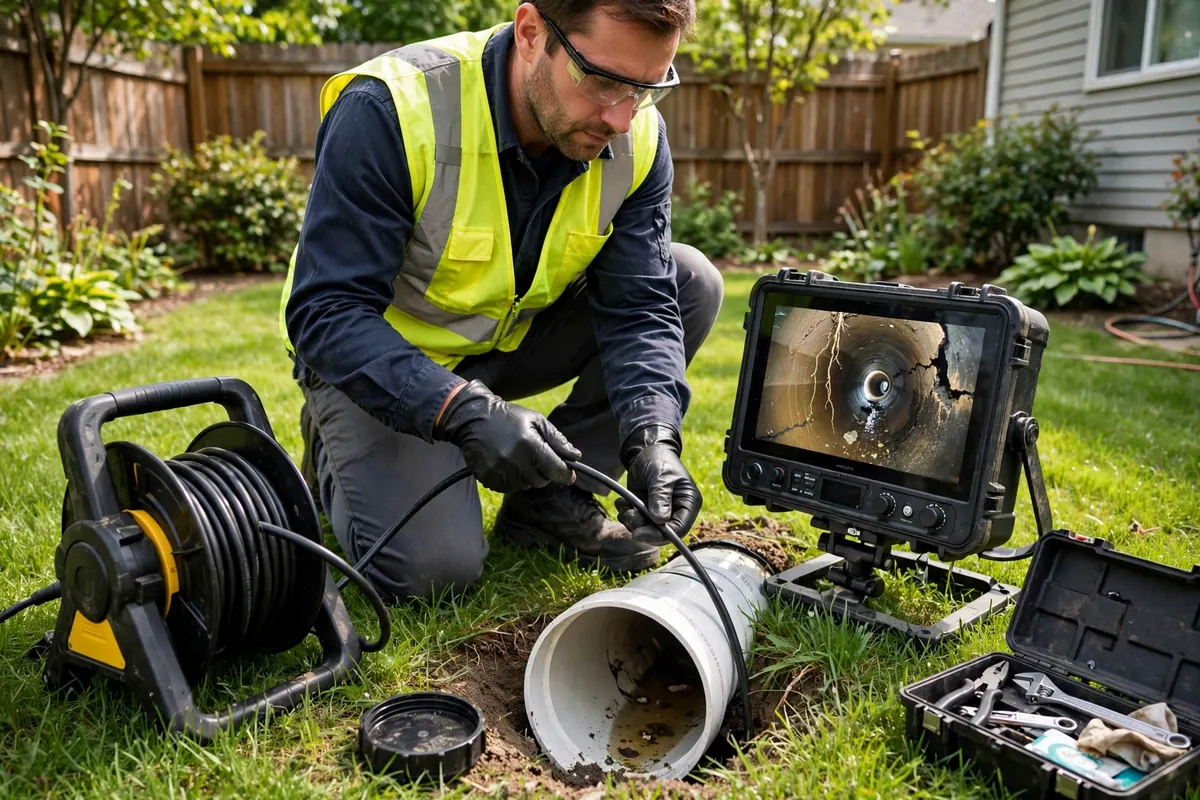
When drains gurgle, back up, or run slow, the problem is underground where nobody can see it. A sewer camera inspection sends a high-resolution camera through the line and shows exactly what's wrong — on video, in real time. No guessing, no exploratory digging. For Perris homebuyers, the most valuable use is often pre-purchase: a sewer lateral replacement is one of the most expensive surprises a buyer can inherit, and a camera inspection reveals its condition before you commit.
Note on terminology: 'drain camera inspection,' 'sewer camera inspection,' and 'CCTV drain survey' all describe the same equipment and procedure. Consumers use the terms interchangeably, and so do we — one page covers both, with sections for sewer-line and drain-line contexts.
Signs You May Need Sewer Camera Inspection
- Recurring drain backups or slow drains
- Gurgling sounds from toilets or drains
- Sewage odors inside or outside
- Lush green strips over the sewer line
- Older home with unknown pipe condition
- Planning a major landscaping or remodel project
What the Camera Actually Sees
The camera reveals the line's condition foot by foot: root intrusion (the most common find in older neighborhoods), cracks and fractures, bellies (sagging sections that collect waste), offsets (separated joints), scale buildup, and foreign objects. Each finding is recorded with its distance from the access point, so a repair crew knows exactly where to dig — if digging is needed at all. We also note pipe material and approximate age where visible — cast iron, clay, Orangeburg, or PVC each fail in characteristic ways, and knowing what's in the ground shapes what comes next.
Sewer Lines vs Drain Lines
The sewer lateral carries everything from your house to the city main — it's the big-picture line, and the one that fails expensively. Drain lines are the smaller branches serving kitchens, baths, and laundry. Same camera, same procedure; the difference is which pipe we're in and what the findings mean for you. We inspect whichever the symptoms point to.
What a Camera Can and Cannot Tell You
Honest scope matters here. A camera can show physical defects — breaks, roots, bellies, offsets — and their exact locations. It cannot measure water loss, find a pressurized supply-line leak, or see through standing water clearly. It also can't assess the outside of the pipe. If your problem is a supply leak rather than a drain defect, acoustic or thermal methods are the right tools, not a camera.
Roots and Perris Soil
Perris's mature trees and irrigated landscaping make root intrusion a recurring find — roots seek the moisture at tiny joint separations, then widen them over seasons. Clay soil movement adds joint stress. A camera inspection every few years on an older line is cheap insurance against a surprise backup.
What You Get After the Inspection
Video footage with distance markers, a plain-language explanation of every defect found, and the footage location of each problem. If the line is healthy, you get that in writing too — useful documentation for buyers, sellers, and property managers.
Suspect a sewer camera inspection?
One visit confirms it and marks the exact position — before anyone digs.
☎ Call +1 951-508-0132Our Sewer Camera Inspection Process
Access the line
Camera enters through an existing cleanout or pulled toilet — no digging to start.
Run the camera
High-resolution video travels the full line, recording defects with distance markers.
Locate problems
A sonde in the camera head lets us mark defect positions on the surface.
Review the footage
You see what we see — defects explained in plain language, with the video to keep.