
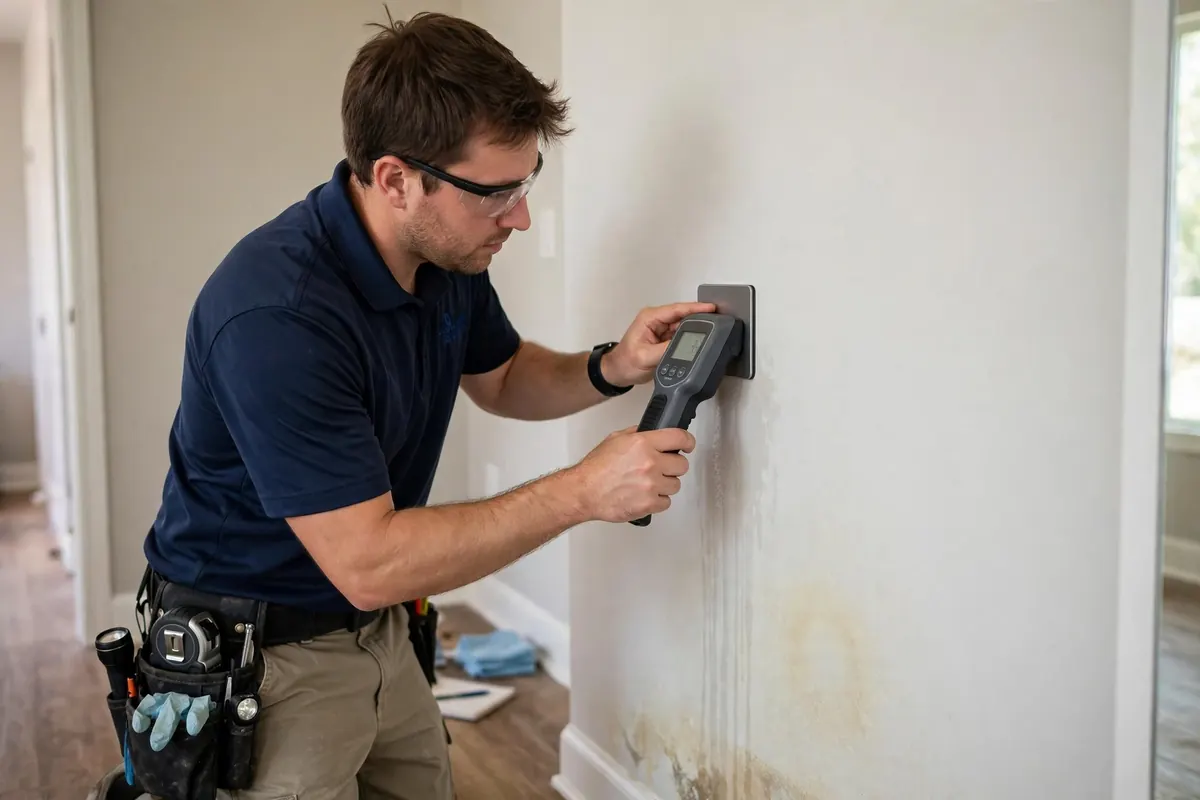
A stain on the ceiling. Paint bubbling on a wall. A musty smell with no visible source. These are symptoms, not diagnoses — the water you see is rarely directly below the leak, because water travels along pipes, joists, and drywall before it shows itself. Finding the source is the job.
Our method for building cavities is moisture mapping: thermal imaging to survey large areas fast, plus pinless moisture meters to confirm active wetness — a systematic map of where moisture is, how far it has spread, and where it originates. Same method for walls and ceilings; same page. Because the method is identical for both, one investigation covers walls and ceilings together — no need for two separate service calls.
Signs You May Need Hidden Wall & Ceiling Leak Detection
- Water stains on ceilings or walls
- Bubbling paint or peeling wallpaper
- Musty odors in a specific room
- Soft or sagging drywall
- Mold returning after cleaning
- Stains that grow after rain or plumbing use
Why the Stain Lies About the Source
Water follows gravity and the path of least resistance. A leak at a second-floor shower valve can travel along a joist and stain a ceiling ten feet away; a pinhole in a wall pipe can wick downward and appear as a baseboard stain. Chasing the stain with a saw is how small problems become big holes. Moisture mapping traces the wetness back to its origin before anyone opens anything.
Moisture Mapping: The Method
'Moisture mapping' is our term for the systematic process: first a thermal-imaging sweep finds every thermal anomaly across walls and ceilings, then pinless meters confirm which anomalies are actively wet, then readings are taken in a grid to draw the moisture's boundaries. The result is a map — wettest at the source, drying outward — that points to where the water is coming from, not just where it ended up.
Supply Leak, Drain Leak, or Roof?
Not every ceiling stain is plumbing. A stain that grows during rain points roofward; one that grows with shower or toilet use points to drain or supply lines; a constant stain regardless of weather suggests a pressurized supply leak. Part of the investigation is ruling candidates out — we'd rather tell you it's the roof flashing than sell you a plumbing investigation you don't need.
Walls and Ceilings: Same Investigation
Some companies split these into two services. We don't — the diagnostic method is identical (thermal survey + moisture confirmation + source tracing), and the consumer intent is the same ('where is this moisture coming from?'). One thorough page, one thorough investigation.
After the Source Is Found
You get the source location, the mapped extent of moisture (which tells a restoration contractor exactly what needs drying), and documentation of our findings. If the source is a supply line, our acoustic work pinpoints the exact break; if it's a drain, camera inspection takes over. The investigation hands off cleanly instead of starting over.
Suspect a hidden wall & ceiling leak detection?
One visit confirms it and marks the exact position — before anyone digs.
☎ Call +1 951-508-0132Our Hidden Wall & Ceiling Leak Detection Process
Thermal survey
Infrared camera sweeps walls and ceilings for thermal anomalies.
Moisture confirmation
Pinless meters verify which anomalies are actively wet.
Grid mapping
Readings taken in a grid draw the moisture's boundaries and gradient.
Source tracing
The wettest point and pattern reveal the origin — supply, drain, or external.
Document
Mapped extent and source documented for your plumber or restoration contractor.