
A pool that needs constant refilling, a spa that drops overnight, a fountain that won't hold its level — water features leak in ways that are maddening to find because the 'plumbing' is buried, underwater, and spread across equipment pads. Leak isolation is the process of dividing the system and testing each part until the loser is found.
Following the industry's own architecture (the national specialists bundle all three), one page covers pools, spas, and fountains — the diagnostic logic is the same, only the vessel changes. No invented evaporation statistics here: just the tests that separate real leaks from normal loss. The same systematic approach works for all three: test, isolate, confirm — whether the vessel holds 20,000 gallons or 200. Skipping steps is how pool owners end up paying for three repairs instead of one.
Signs You May Need Pool, Spa & Fountain Leak Detection
- Pool needing frequent refilling
- Water level dropping visibly overnight
- Soggy ground around pool equipment
- Air bubbles in pool returns
- Spa losing water faster than the pool
- Fountain basin that won't hold level
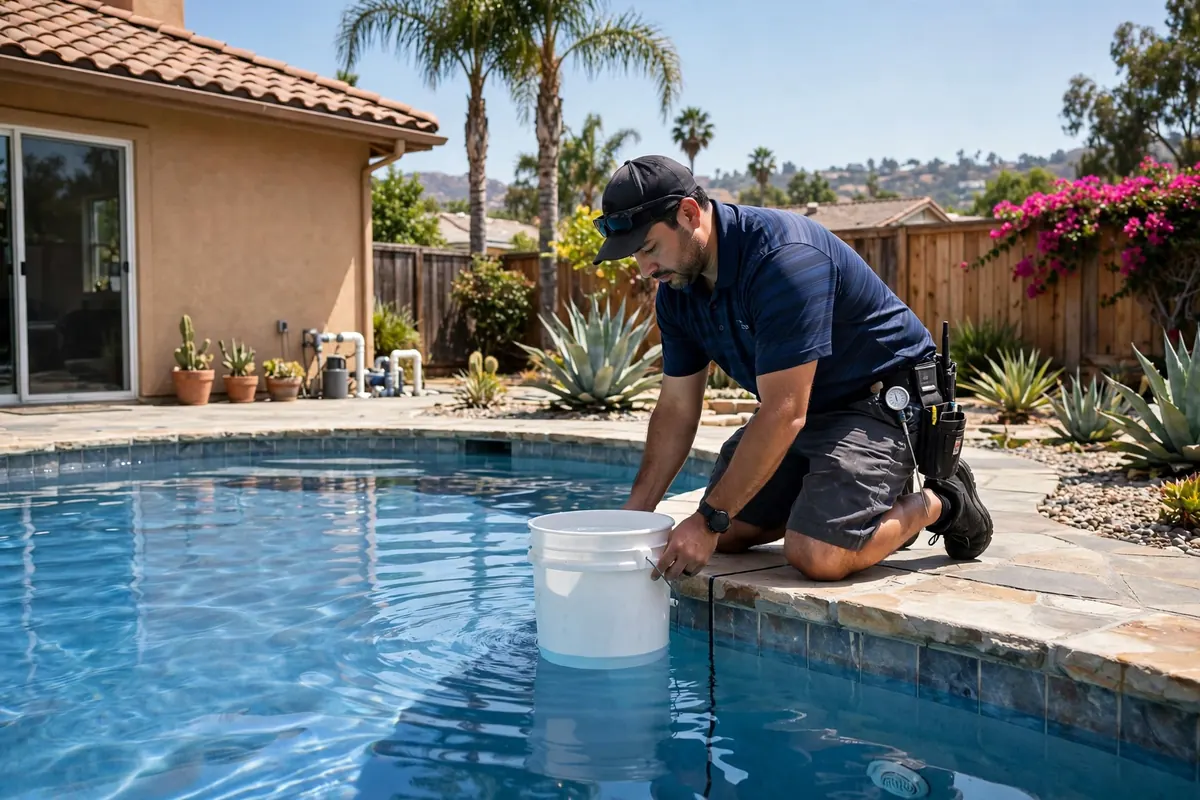
Leak or Evaporation? The Bucket Test
Before any investigation, run the bucket test: fill a bucket with pool water, set it on a pool step, mark both the bucket level and the pool level, and compare after 24 hours with the pump running normally. If the pool drops more than the bucket, water is leaving through something other than evaporation — you have a leak. (We deliberately avoid quoting 'normal' evaporation rates as universal facts; heat, wind, and humidity vary too much.)
Pump-On vs Pump-Off: The Key Diagnostic
Run the bucket test twice: once with the pump running, once with it off. If the loss is worse pump-on, the leak is in the pressurized side — returns, cleaner lines, equipment. If worse pump-off, it's on the suction side or in the shell itself — skimmers, main drain, light niches. This single comparison cuts the search area dramatically before any equipment comes out.
Isolating the System
Isolation means pressure-testing each line independently: skimmer line, main drain, returns, cleaner line, spa jets, fountain feeds. Lines that hold pressure are cleared; the one that doesn't is the culprit. Dye testing then pinpoints the exact crack or fitting failure at the isolated component. It's methodical, not magical — and it's why isolation beats randomly resealing everything.
Spas and Fountains
Spas add jets, air blowers, and heater unions — more fittings, more suspects — but the isolation logic is identical. Fountains are simpler vessels with exposed plumbing that's often easier to trace. Both get the same systematic treatment: bucket test, pump comparison, line isolation, dye confirmation.
Perris Pool Reality
Inland Empire heat means pools run hard and long, and older equipment pads develop the full catalog of failures: cracked skimmer throats, deteriorated light niches, separated return fittings. If your pool is more than a decade old and the autofill runs constantly, an isolation test usually pays for itself in water savings alone.
Suspect a pool, spa & fountain leak detection?
One visit confirms it and marks the exact position — before anyone digs.
☎ Call +1 951-508-0132Our Pool, Spa & Fountain Leak Detection Process
Bucket test
24-hour test separates real leaks from evaporation before anything else.
Pump comparison
Pump-on vs pump-off loss patterns point to pressure side or suction/shell side.
Line isolation
Each plumbing line is pressure-tested independently until the loser is found.
Dye confirmation
Dye testing pinpoints the exact crack or fitting at the isolated component.