
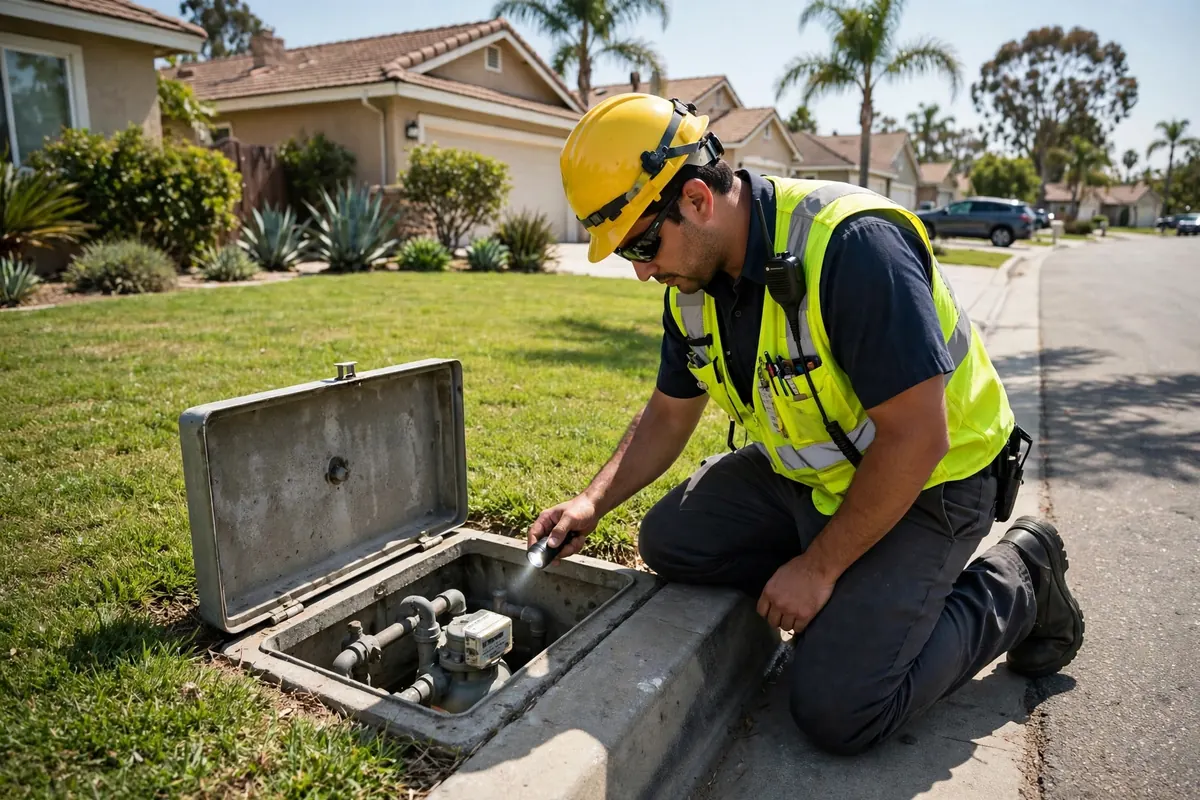
The main water line runs underground from the meter to your house — and when it leaks, the water never surfaces where you'd expect. It drains into soil, sometimes for months, while your bill climbs into EMWD's most expensive tiers. Main water line leak detection finds the break without trenching the yard to look for it.
This page covers what some call 'underground pipe locating' and others call 'main line locating' — they're the same homeowner problem: a buried service line losing water. We trace the line's route, then pinpoint the leak along it, and we document the difference between private-line detection and the free 811 public utility marking below.
Signs You May Need Main Water Line Leak Detection
- Water bill spike with no visible leak
- Soggy patches or lush strips in the yard
- Water meter moving with everything off
- Sound of running water near the meter or yard
- Low water pressure throughout the house
- Cracks or settling in driveway/walkway
How a Main Line Leak Behaves
The service line is pressurized, so a break jets water into the surrounding soil. In Perris's expansive clay, that water can travel along the pipe trench and surface far from the break — or never surface at all, draining into deeper soil. The reliable evidence is the meter: if it moves with every fixture off, the loss is between the meter and the house, and it's real.
Tracing the Line: Pipe Locating as a Method
Before we can find the leak, we need the line's route. Using electronic pipe tracing, we follow the buried service line from the meter to the house and mark its path across the yard. This is locating as a diagnostic step — not a standalone utility-marking service. Once the route is known, acoustic listening walks the line to find where the leak's sound peaks.
Private Detection vs 811 Public Marking
Calling 811 gets the public utilities marked for free before you dig — it does not find your leak and does not cover your private service line. Our work is the private side: tracing your line and pinpointing the break. The two are complementary, not interchangeable.
Hydrostatic Testing: When a Pressure Test Helps
Sometimes listening isn't conclusive — for example, with plastic pipe that muffles sound, or a leak too small to hear. Then we use pressure testing as a diagnostic method. On the drain side, a hydrostatic test means sealing the line with a test ball, filling it with water, and watching the level for 15–30 minutes: a drop proves a leak. On the supply side, a static pressure test watches a gauge for decay with the line isolated. Both are investigation tools, not services on their own — and we don't do fire-sprinkler or backflow testing, which are regulated specialties requiring certified testers.
The EMWD Billing Angle
Eastern Municipal Water District bills on tiers — and a main-line leak can silently push a household into the steepest ones. If your bill jumped, compare usage in gallons (not dollars), run the two-hour meter test, and ask EMWD about leak adjustments for documented repairs. Finding the leak quickly is what stops the financial bleeding either way.
Suspect a main water line leak detection?
One visit confirms it and marks the exact position — before anyone digs.
☎ Call +1 951-508-0132Our Main Water Line Leak Detection Process
Meter test
Two hours, all water off — meter movement proves the loss is on your side.
Trace the route
Electronic pipe tracing marks the buried line's path from meter to house.
Acoustic walk
Listening equipment follows the traced route to the leak's loudest point.
Pressure-test if needed
Hydrostatic or static testing confirms when sound alone isn't conclusive.
Mark and document
Break location marked on the surface with a written summary for your contractor.